
Every day, millions of people get behind the wheel completely confident they are safe, careful drivers. They buckle up. They check their mirrors. And then, somewhere between the driveway and the destination, they glance at a text message, adjust the GPS, reach for a coffee cup, or drift into a full-blown conversation that pulls their mind somewhere else entirely. They don’t think of this as dangerous. Most of them don’t think of it at all.That’s exactly the problem.
Distracted driving isn’t a niche behavior practiced by reckless teenagers or careless commuters. It’s something the overwhelming majority of drivers do frequently, casually, and without much guilt. Understanding just how widespread it is requires taking an honest look at what distraction actually means, why humans are so bad at recognizing it in themselves, and what the real-world consequences look like.
Distracted Driving Is Far More Common Than You Think
Every day, millions of people get behind the wheel completely confident they are safe, careful drivers. They buckle up. They check their mirrors. And then, somewhere between the driveway and the destination, they glance at a text message, adjust the GPS, reach for a coffee cup, or drift into a full-blown conversation that pulls their mind somewhere else entirely. They don’t think of this as dangerous. Most of them don’t think of it at all.That’s exactly the problem.
Distracted driving isn’t a niche behavior practiced by reckless teenagers or careless commuters. It’s something the overwhelming majority of drivers do frequently, casually, and without much guilt. Understanding just how widespread it is requires taking an honest look at what distraction actually means, why humans are so bad at recognizing it in themselves, and what the real-world consequences look like.
What Counts as Distracted Driving?
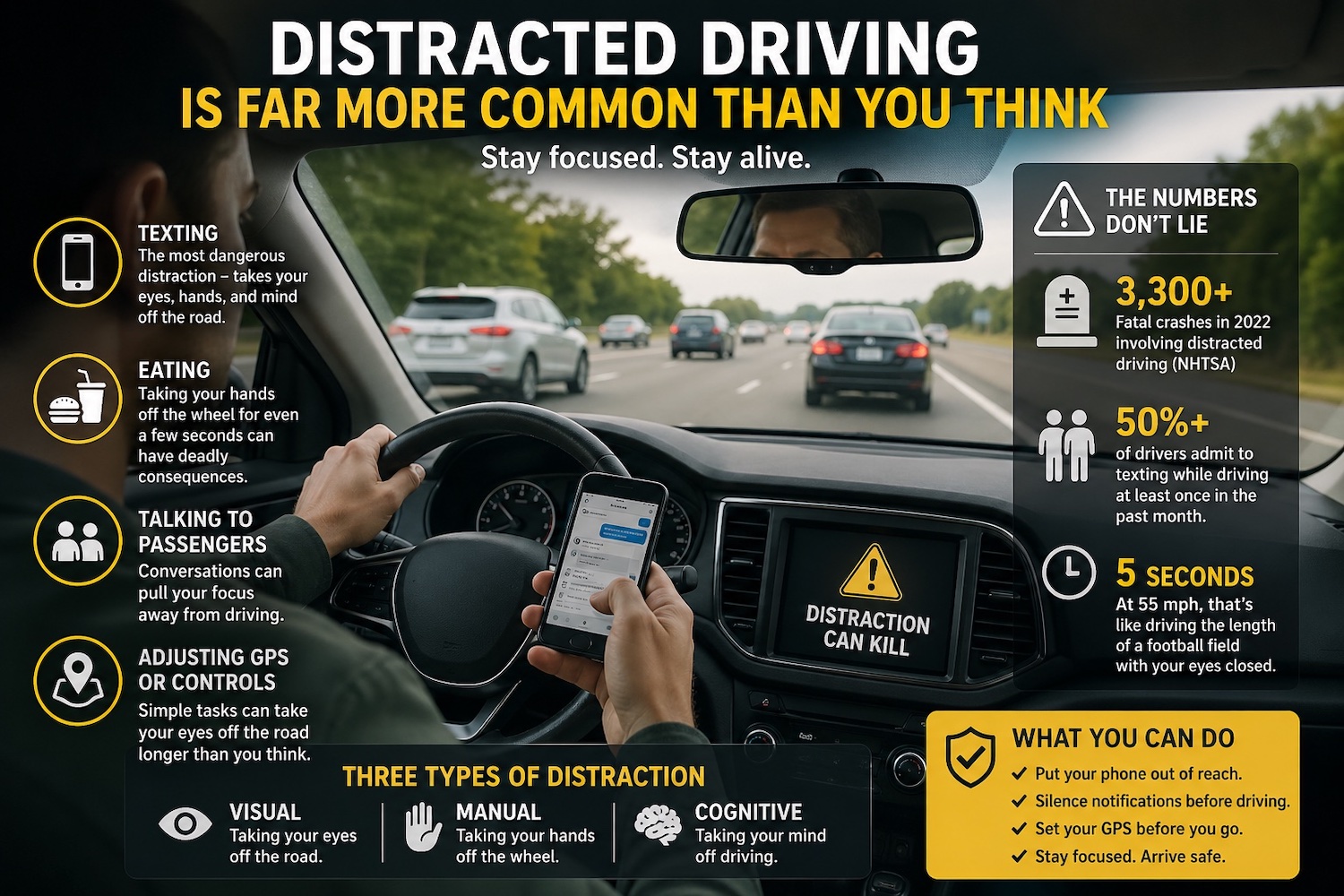
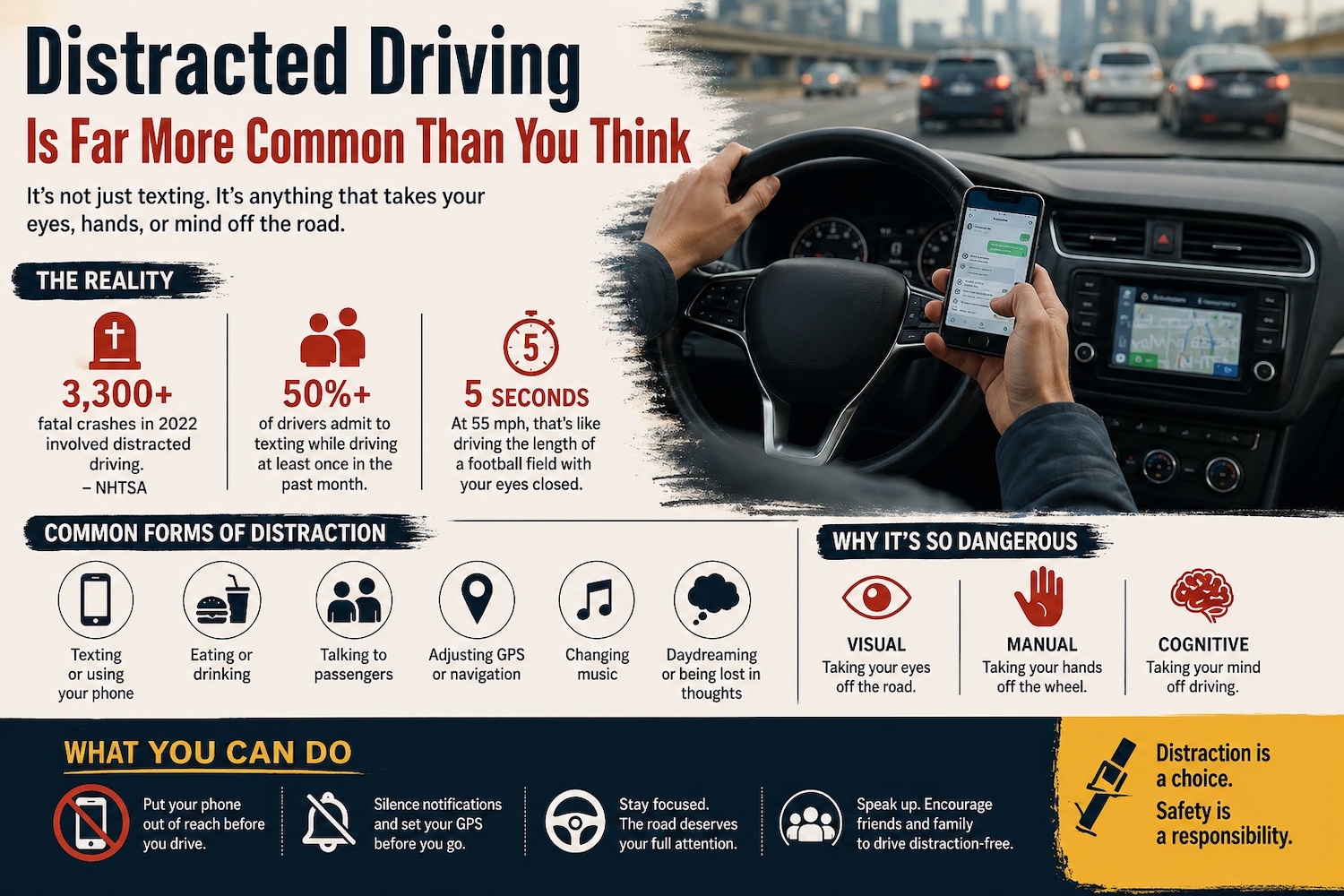
When people hear “distracted driving,” most picture someone typing out a text at 70 miles per hour. That image is accurate but incomplete. Distraction behind the wheel comes in three distinct forms: visual (taking your eyes off the road), manual (taking your hands off the wheel), and cognitive (taking your mind off driving).
Texting is uniquely dangerous because it hits all three at the same time. But plenty of other behaviors are just as disruptive without feeling nearly as obvious.
Eating while driving. Changing a song. Talking to a passenger. Daydreaming about an argument that happened two hours ago. Setting a navigation destination. All of these pull a driver’s attention away from the road, even briefly, and brief is often all it takes.
At 55 miles per hour, taking your eyes off the road for five seconds is roughly equivalent to driving the length of a football field with your eyes closed. That’s not a dramatic exaggeration; it’s a straightforward calculation of time and distance.
The Numbers Tell a Grim Story
According to the National Highway Traffic Safety Administration, distracted driving kills thousands of Americans every year. In 2022, distraction was reported as a factor in over 3,300 fatal crashes. That figure represents only the cases where distraction was officially noted in crash reports, which means the real number is almost certainly higher, since distraction is notoriously difficult to detect and document after the fact.
Surveys consistently show that a significant percentage of drivers admit to using their phones while driving. One study found that more than half of respondents acknowledged texting while driving at some point in the past month, even though nearly all of them considered it dangerous. The gap between what people know and what they do is staggering.
Young drivers tend to get most of the attention in these conversations, and they do show higher rates of phone use behind the wheel. But distracted driving is not a youth problem. Adults, including experienced and older drivers, engage in it regularly. Experience doesn’t eliminate distraction in some cases; it creates overconfidence that makes people more willing to risk it.
Why People Underestimate Their Own Distraction
There’s a psychological quirk that makes distracted driving so persistent: people are genuinely poor judges of their own attention.
Studies on multitasking have repeatedly shown that most people believe they are better at it than they actually are. The brain doesn’t truly perform two tasks simultaneously; it switches back and forth rapidly, and every switch introduces a small gap where information is missed. Drivers tend to interpret the fact that nothing bad happened as proof that they were paying sufficient attention, rather than as luck.
There’s also the issue of habituation. Once a behavior becomes routine, checking the phone at a red light, eating on the way to work, talking hands-free for hours at a stretch, it stops feeling like a choice and starts feeling like just the way things are. The risk doesn’t decrease, but the perception of it does.
This is part of why awareness campaigns have limited impact. Telling people that distracted driving is dangerous doesn’t change behavior much, because most drivers already know that they just don’t believe it applies to them in that particular moment.
Phones Are the Most Visible Culprit, But Not the Only One
Smartphones deserve their reputation as a serious road hazard. The compulsive pull of notifications, the feeling that something might be happening right now, is difficult to resist even when people know they should. Studies using dashcam footage have found drivers glancing at their phones far more often than they self-report.
Hands-free technology has been widely marketed as a safer alternative, but the cognitive distraction it introduces is still meaningful. A driver on a hands-free call is measurably slower to react to hazards than a driver not on a call at all. The phone is out of their hands, but their mind is partly elsewhere.
In-vehicle infotainment systems, the large touchscreens now standard in most new cars, have introduced a new category of distraction. Operating these systems while driving can take eyes off the road for as long as 40 seconds for some tasks, according to research from the AAA Foundation for Traffic Safety. That’s not a slight inconvenience; it’s a significant safety gap built directly into the car.
The Social and Systemic Dimensions
Distracted driving persists partly because it’s treated as an individual failure rather than a systemic issue. Enforcement is inconsistent and difficult. Laws vary widely by state; some ban all handheld phone use, others only text messaging, and others impose minimal restrictions at all. Even in places with strict laws, the probability of being caught on any given trip is low, which reduces the deterrent effect.
The design of technology plays a role, too. Notification systems are built to demand attention. Car dashboards are increasingly complex. Navigation apps give real-time alerts. None of this is designed with the specific vulnerability of a person traveling at high speed in mind.
Peer behavior matters as well. Drivers who see others using phones without apparent consequence tend to normalize it. And the social expectation of immediate responsiveness, the idea that a message should be answered quickly, that a call shouldn’t be missed, is powerful enough to override conscious safety intentions in many people.
What Actually Works
Enforcement alone hasn’t solved the problem, but it helps when consistent. Hands-free laws with meaningful penalties do reduce phone-related crashes when they’re actually enforced. Automated detection technology cameras that can identify phone use are being piloted in some areas and show promise.
Vehicle design is a more promising frontier. Some manufacturers have introduced features that silence notifications when the car is in motion or that require confirmation before a driver can interact with the infotainment screen. These defaults matter because they remove the decision from the driver in the moment when willpower is least reliable.
At the individual level, the most effective strategy is simple but not easy: put the phone somewhere physically inaccessible before starting the car. The glove box, the back seat, and a bag in the trunk. Out of reach removes it from consideration entirely. No notification can compete with a phone that literally cannot be reached.
When Distraction Leads to a Crash: The Legal Side
Statistics and safety habits matter, but so does what happens after a collision actually occurs. For people who are injured because another driver was on their phone, the road to fair compensation isn’t automatic. Proving distraction in a legal claim is genuinely difficult. Drivers rarely admit to phone use, crash reports often leave it out, and evidence like call logs or app activity can disappear quickly if no one moves to preserve it.
This is where legal action becomes part of the conversation. If you or someone close to you has been hurt in a collision caused by a distracted driver, understanding how Distracted driving is far more common matters as much as knowing your rights. From subpoenaing phone records to working with crash reconstruction experts, building a solid case requires acting fast before evidence is gone and before insurance adjusters shape the narrative on their terms.
The broader point is that legal accountability is one of the few external pressures that actually change driver behavior. Crashes that carry real consequences, financial, legal, reputational, register in a way that public service announcements simply don’t.
The Honest Reckoning
Distracted driving kills people at a scale that would be treated as a major public health emergency if it looked different, if it came from a pathogen, or a food supply, or a product that wasn’t also something people love and depend on. Instead, it tends to be treated as a background condition, a problem we acknowledge without urgency.
That won’t change until more people accept an uncomfortable truth: they are almost certainly part of the statistic they think they’re separate from. The driver who glances at a message at a stoplight, who eats their breakfast on the highway, or who turns to address a backseat argument that driver is distracted. The road doesn’t grade on effort or intention. It just records what happens.